Fire dampers are installed in air ducts where they pass through fire-rated walls and floors. In a fire, the damper closes so that flame and smoke cannot travel along the duct into another fire compartment. The two common types are FD, closed by a thermal fuse, and MFD, closed by an electric motor and interlocked with the fire alarm system.
This article explains the difference between FD and MFD, what the EI rating means, how the GSC damper is built according to its fire test reports, and how to choose a damper for each location.
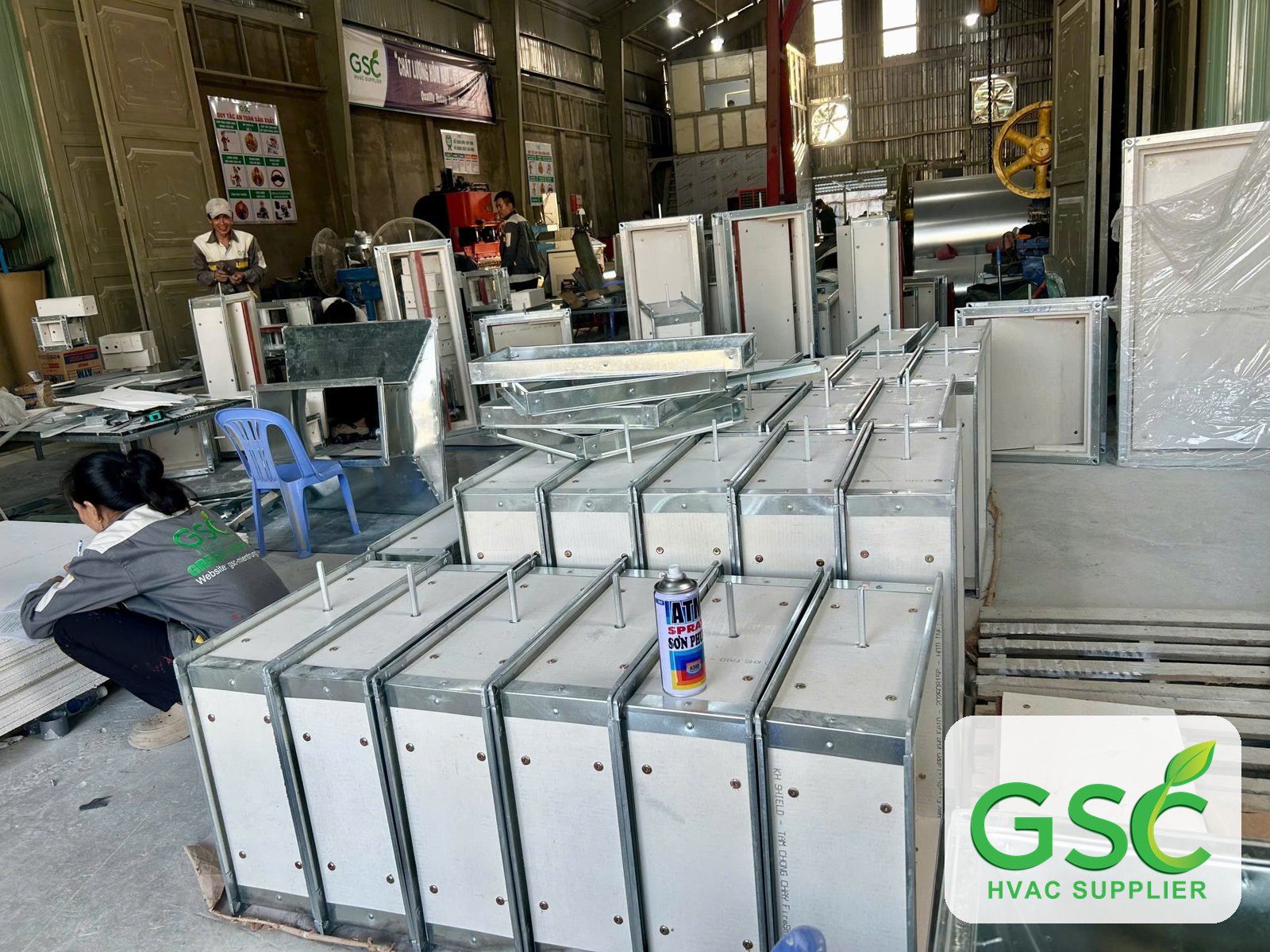
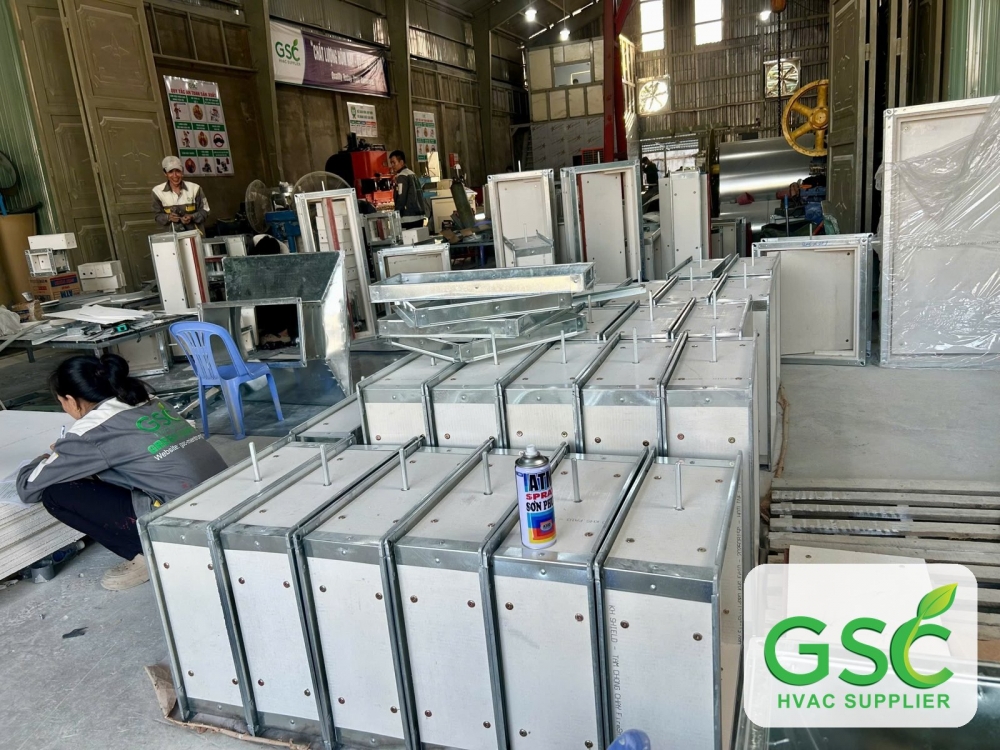
A batch of GSC fire dampers completed at the workshop, awaiting inspection before shipment.
| Criteria | FD damper (thermal fuse) | MFD damper (motor) |
|---|---|---|
| Closing mechanism | Thermal fuse melts at 70 °C and a spring pulls the blade closed | Spring-return electric motor, closes on signal or on power loss |
| Activation | When the duct air temperature reaches the fuse threshold | Signal from the fire alarm panel/BMS, without waiting for heat |
| Status feedback | Optional limit switch | Status signal sent back to the control centre |
| Reopening after closing | Replace the fuse and reset by hand | Reopens electrically, easy to test periodically |
| Typical application | Ordinary supply/return air-conditioning and ventilation ducts | Buildings with interlocked fire alarms: high-rise, factories, hospitals, smoke extract |
| Cost | Lower | Higher (motor, control wiring) |
Quick rule: if the fire protection design requires the damper to close on a fire alarm signal or to be monitored remotely, choose MFD; use FD for the remaining locations to save cost. The damper type, location and EI rating always follow the approved design documents.
The required fire resistance of a fire damper is set in QCVN 06:2022/BXD (and Amendment 1:2023), depending on the fire rating of the wall or floor the duct passes through. The test method for mechanical fire dampers is ISO 21925-1:2018 (equivalent to TCVN 14394-1:2025), run together with TCVN 9311-1.
Green Supply (GSC) fire dampers have been tested at two accredited laboratories under ISO 21925-1:2018:
| Damper type | Sample size (mm) | Result | Test laboratory | Date |
|---|---|---|---|---|
| FD fuse type (GSC-FD/EI150) | 1,700×700×200 | EI150, sustained 152 minutes | Phuong Nam Fire Protection Technology Co., Ltd (LAS-XD 1646) | 08/2025 |
| FD fuse type | 1,560×780 | EI60, sustained 62 minutes | Phuong Nam Fire Protection Technology Co., Ltd (LAS-XD 1646) | 03/2025 |
| MFD motorized | 1,580×780 | EI60 | Phuong Nam Fire Protection Technology Co., Ltd | 03/2025 |
| MFD motorized (single module) | 1,700×850×200 | Passed EI134 (EI120 required) | Vietnam Institute for Building Materials – VIBM (VILAS 003) | 02/2026 |
| MFD combined | 1,700×1,700×200 | Passed EI121 (EI120 required) | Vietnam Institute for Building Materials – VIBM (VILAS 003) | 05/2026 |
| FD combined (fuse type) | 1,700×1,700×200 | Passed EI121 (EI120 required) | Vietnam Institute for Building Materials – VIBM (VILAS 003) | 05/2026 |
According to the scope stated in the reports, the results apply to dampers of the same construction and equal or smaller size than the tested sample. That is why GSC tested large samples: a single MFD module up to 1,700×850 mm, and combined assemblies up to 1,700×1,700 mm, remain within the scope of the reports.
Some reports were commissioned by a company in the same group as GSC (Viweco Joint Stock Company); GSC is permitted to use these reports within the group.
See the full set on the Fire protection product certificates page.
The damper is built to the same construction as the tested sample. Main specifications per the reports:
| Component | Construction per the fire test reports |
|---|---|
| Damper body | 1.15 mm galvanized steel, U-shaped, 200 mm deep; clad with fire-resistant board per the test report (MgO or 10 mm fire board, density 950–1,000 kg/m³) on both inside and outside faces |
| Blade | Multiple layers of fire-resistant and insulating materials: 10 mm fire board, 20 mm MgO, 0.75 mm galvanized steel layer; all 4 edges coated with Hilti FS-ONE MAX intumescent sealant |
| Connection flange | 35 mm high TDC flange, 1.15 mm galvanized steel |
| Blade stop | Assembled fire board, fixed with self-drilling screws |
| Closing mechanism – FD | V-70 thermal fuse, melting point 70 °C; steel spring |
| Closing mechanism – MFD | Spring-return electric motor mounted on the damper body; galvanized steel drive shaft |
| Smoke leakage in fire | < 360 m³/(h·m²), meets ISO 21925-1 |
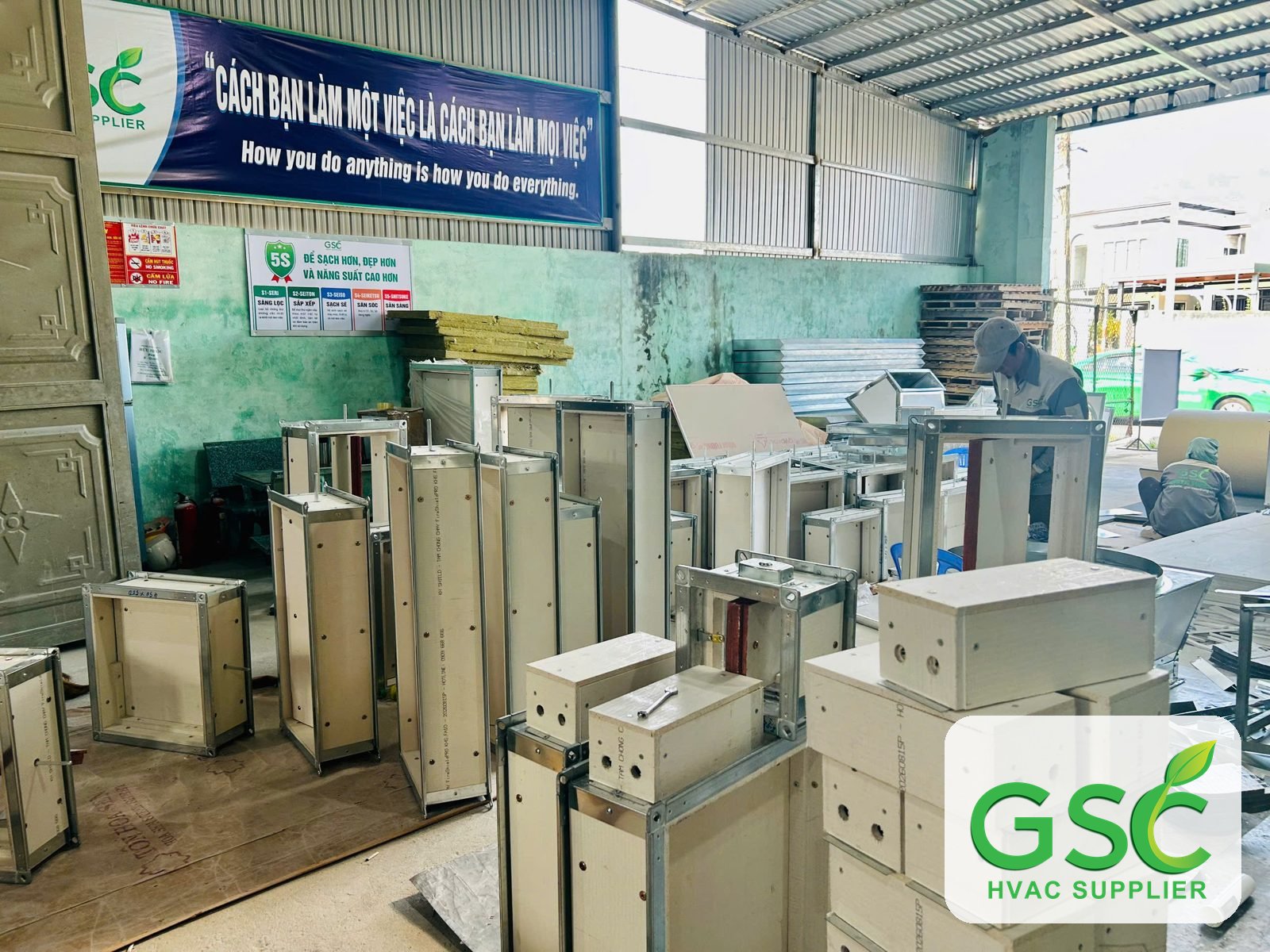
Fabricating the damper body: 1.15 mm steel clad with fire-resistant board.
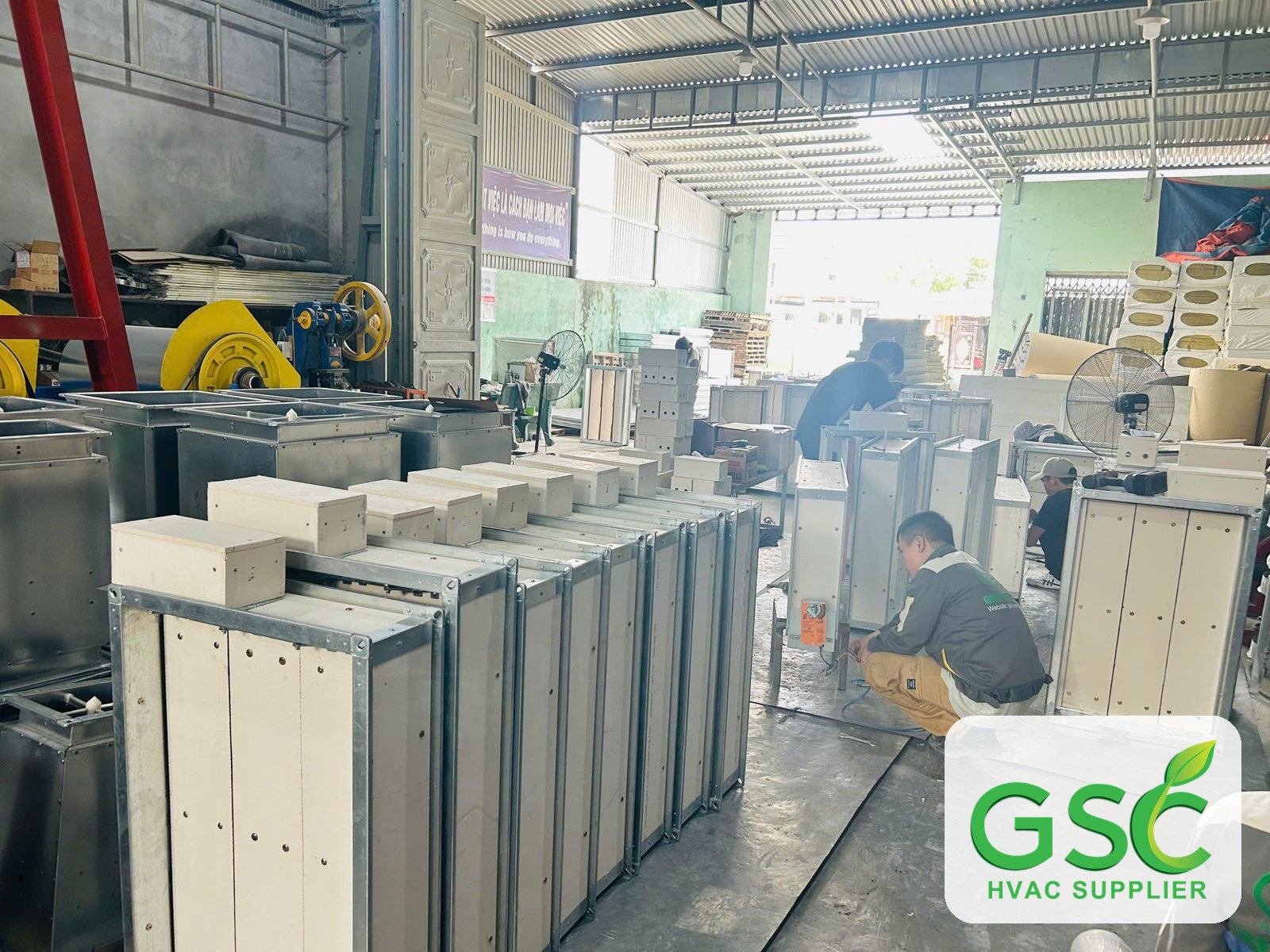
GSC fire damper awaiting motor installation and operation check.
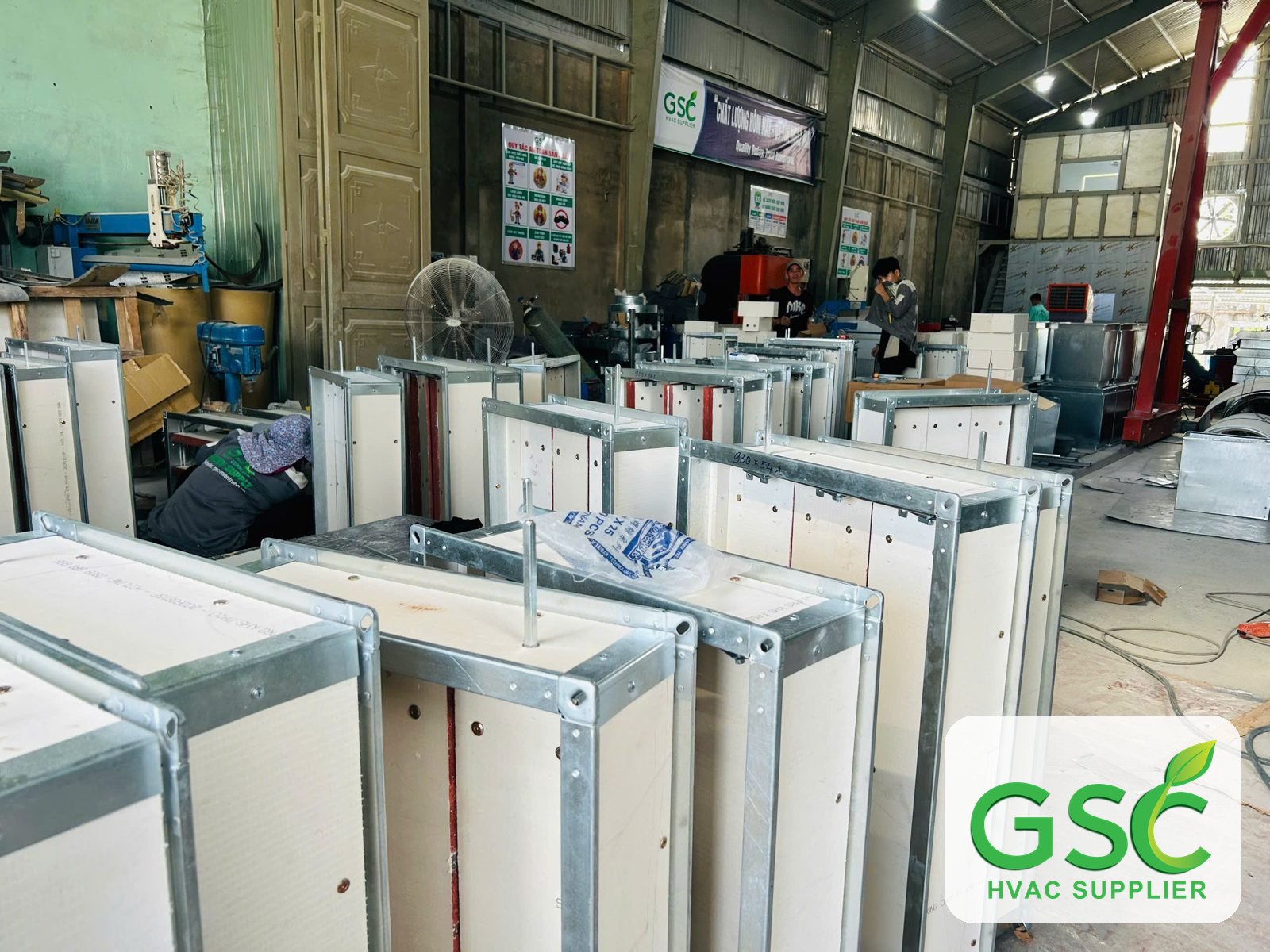
A batch of GSC fire dampers completed and ready for shipment.
How do an MD damper and an MFD damper differ? An MD (motorized damper) is a control damper driven by a motor to open, close or modulate airflow, and has no fire resistance. An MFD is a motorized fire damper that has been tested to an EI rating. Never use an MD in place of an MFD where a duct passes through a fire wall.
Can a damper rated EI120 or EI150 be used where EI60 is required? A damper with a higher fire resistance meets a lower requirement, provided the construction, size and installation stay within the scope of the report. The fire protection design engineer makes the final confirmation.
What about dampers larger than 1,700×850 mm? Use a combined damper assembled from modules, within the report scope up to 1,700×1,700 mm. Larger sizes should be discussed with GSC in advance.
How fast does an MFD close? In testing, the MFD damper closed fully 20–25 seconds after the furnace temperature exceeded 50 °C; on a signal from the fire alarm panel, it closes immediately on command.
Send your damper size list and EI ratings from the drawings via Zalo/Hotline 0905 604 970 or email gsc.mientrung@gmail.com. GSC quotes with the test report package suited to each size.
View the FD/MFD damper product page · View the fire test reports