In buildings such as factories, shopping centers, hospitals, hotels and high-rise buildings, the standby generator room is an area that produces very high noise levels when running. Without a suitable solution, noise travels through the ventilation system and directly affects the working environment and surrounding areas.
One of the key devices for controlling this problem is the generator room silencer (an acoustic duct or noise attenuator for the ventilation system).
A generator room silencer is a device installed in the supply air duct or exhaust air duct of a generator room to reduce noise caused by airflow and the engine, while still maintaining the ventilation airflow needed to cool the generator.
It is usually a rectangular or round box fitted inside with acoustic baffles combined with specialist sound-absorbing material . As air passes through, sound waves are absorbed and significantly reduced before reaching the outside.
A running generator produces noise from several sources:
Engine noise.
Cooling fan noise.
Noise from high-velocity airflow.
Vibration transmitted through the duct system.
Building a soundproof room without treating the air paths still lets noise escape through the air intake and exhaust openings.
A generator room silencer is the solution that limits this, improving the overall sound insulation of the plant room.
This is the most important function of a silencer. It absorbs and cancels part of the sound energy before the air is released outside.
A generator needs enough air for cooling and stable operation. Generator room silencers are designed to reduce noise while maintaining the airflow required by the design.
Silencers work together with:
Soundproof walls
Fire-resistant materials
Duct systems
Fire doors
Together they form an integrated noise control system.
For many industrial and residential projects, noise control is an important criterion during acceptance of the mechanical and electrical (MEP) systems. Using the right silencer helps the project meet environmental and operational requirements.
A generator room silencer usually consists of:
An outer casing of galvanized steel or protective painted steel.
Parallel acoustic baffles that create paths for the airflow.
A layer of specialist acoustic material that absorbs sound waves.
A reinforcing frame that ensures rigidity and durability in operation.
Depending on the airflow, duct size and required noise reduction, the silencer is designed with different dimensions and numbers of baffles.
A silencer system is usually installed in the following steps:
Surveying the existing conditions and technical requirements.
Calculating the airflow and the required noise reduction.
Fabricating the silencer to the design dimensions.
Installing it together with the duct system.
Checking airtightness, airflow and noise reduction before handover.
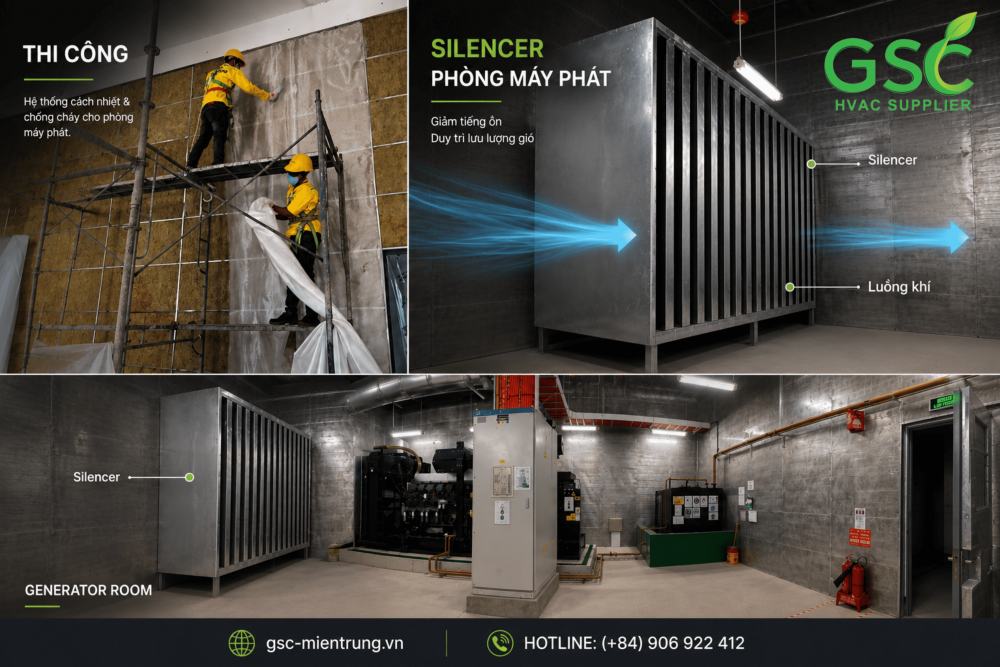
The photos show the process of:
Installing thermal insulation and fire protection for the plant room.
Installing the generator room silencer in the ventilation system.
Completing the generator room with ductwork, MEP equipment and an integrated noise reduction solution.
These are key items to ensure the system runs stably and safely while minimizing noise released into the environment.
For the best results, a generator room silencer should be selected based on:
Airflow of the system.
Air velocity in the duct.
Required noise reduction (Insertion Loss).
Size and available installation space.
Compatibility with the existing duct system .
Fire resistance and durability requirements for the operating environment.
Choosing the wrong equipment can increase pressure loss, reduce ventilation effectiveness or fail to achieve the desired noise reduction.
Working in the HVAC sector, GSC Central Vietnam provides integrated solutions for generator rooms, including:
Noise-reducing silencers
Duct systems
FD/MFD fire dampers
EI fire-rated ducts
Custom HVAC fabrication and installation to project requirements.
With real manufacturing and installation capabilities, GSC Central Vietnam is committed to providing solutions that optimize ventilation airflow, reduce noise, improve operating efficiency and meet the technical requirements of every project.
Contact GSC Central Vietnam