VAV box (Variable Air Volume box) is a terminal unit in a central air-conditioning system. It automatically adjusts the amount of cold air supplied to each zone according to the actual room temperature. Instead of blowing the same airflow into every room, a VAV box supplies only what each zone needs: lightly occupied rooms do not get over-cooled, the AHU fan runs lighter and the electricity bill goes down.
This article summarizes the construction, operating principle, specification tables and sizing method for VAV/CAV boxes according to the 2026 GSC catalogue, for design engineers, MEP contractors and project owners.
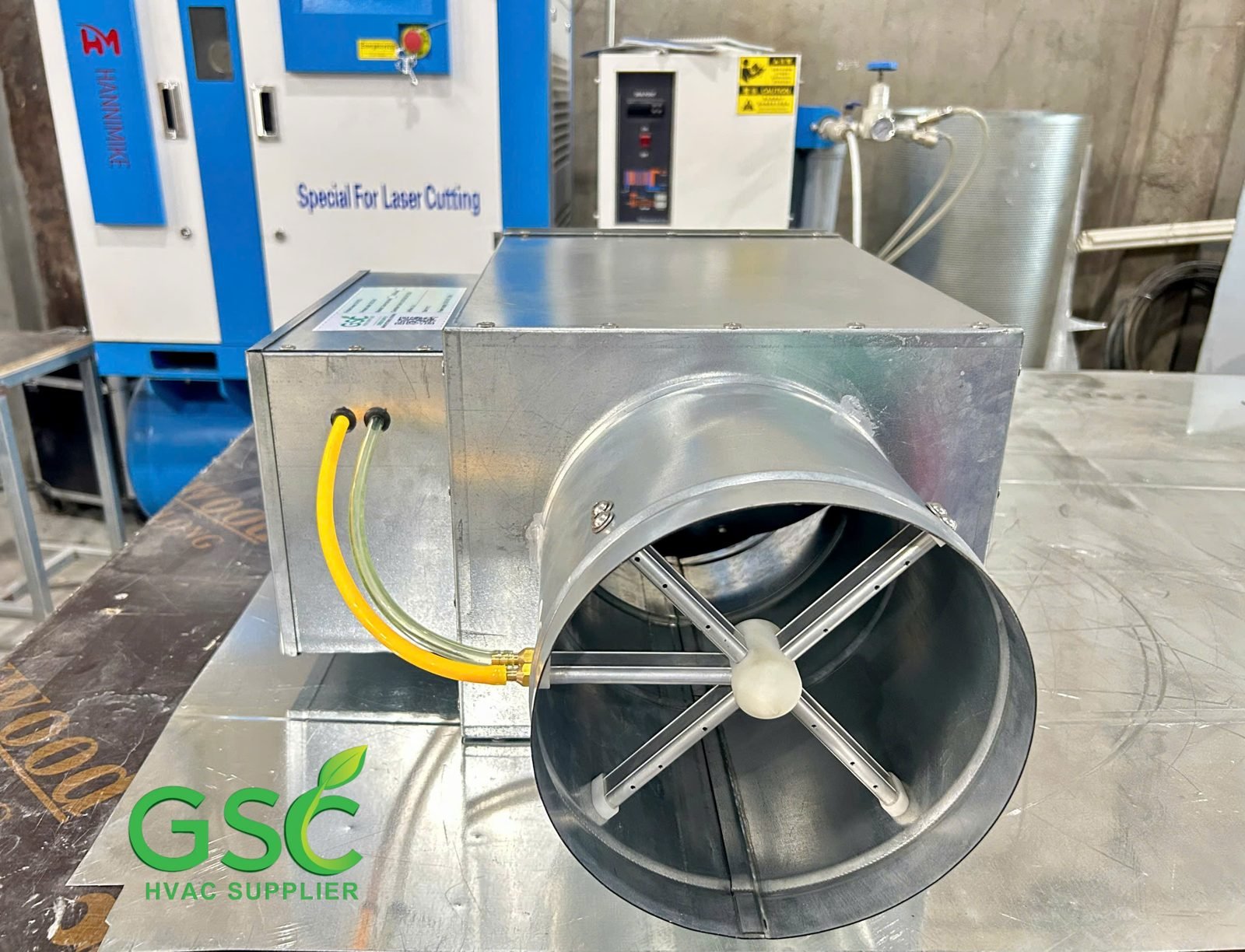
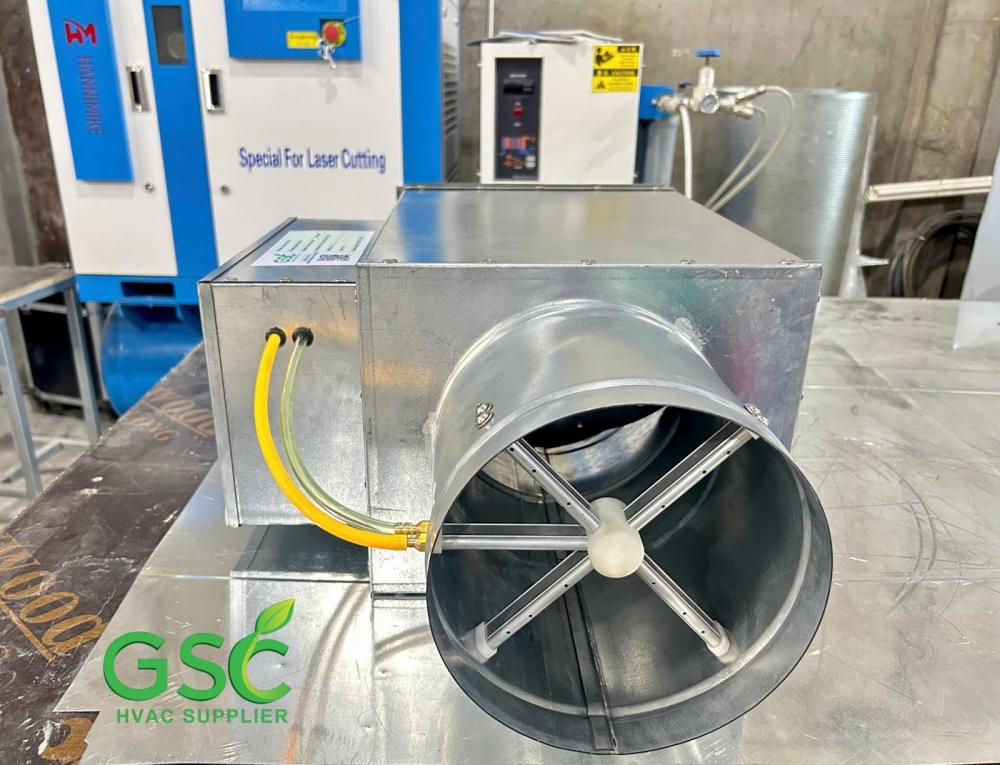
GSC single-duct round VAV box with Belimo controller, manufactured at the GSC workshop.
| Criteria | VAV box | CAV box |
|---|---|---|
| Airflow | Varies with zone demand | Held at a fixed set value |
| Control | Thermostat + controller + flow sensor | Controller holds a constant flow, no thermostat needed |
| Typical applications | Offices, hotels, shopping centres, schools, hospitals | Fresh-air supply, exhaust, areas needing stable airflow |
| Energy saving | High: AHU fan slows down when load drops | Lower |
Both lines share the same box body and size table; GSC designates them GSC-VAV.xx and GSC-CAV.xx.
The thermostat measures room temperature and the differential-pressure sensor measures the actual airflow through the inlet. The controller compares it with the setpoint and drives the actuator to open or close the damper. A VAV box works in 3 modes:
Because it controls on measured airflow, the GSC VAV box is pressure independent: the airflow into the room does not drift when the main duct pressure fluctuates. When many boxes reduce airflow together, the AHU inverter slows the fan to hold duct pressure, which is where the biggest energy saving comes from.
The box body is made of Zn-Al-Mg alloy-coated steel (Mag Shield). According to the steel manufacturer, this coating resists rust 3–5 times better than ordinary galvanized steel and self-heals at cut edges and drilled holes thanks to its magnesium content, which suits humid and coastal climates such as Central Vietnam.
| Parameter | Value |
|---|---|
| Supply voltage | AC/DC 24 V, 50/60 Hz (AC range 19.2–28.8 V) |
| Motor torque | 5 Nm, 95° rotation angle |
| Flow sensor | Belimo Δp sensor, 0–500 Pa measuring range, no zero adjustment needed |
| BMS communication | BACnet MS/TP or Modbus RTU; peripherals via MP-Bus or analog/digital I/O |
| Control loop | By room temperature or air quality (CO₂) |
| Setup and maintenance | Built-in NFC antenna, configuration by smartphone |
| Protection class | IP20, SELV (safety extra-low voltage) |
Supplied thermostat: Belimo 22RT-A001, with LCD display, sensor accuracy ±0.3 °C (15–30 °C), On/Off/Eco/Boost modes, and CAV switching via app or BACnet. CAV boxes are not supplied with a thermostat.
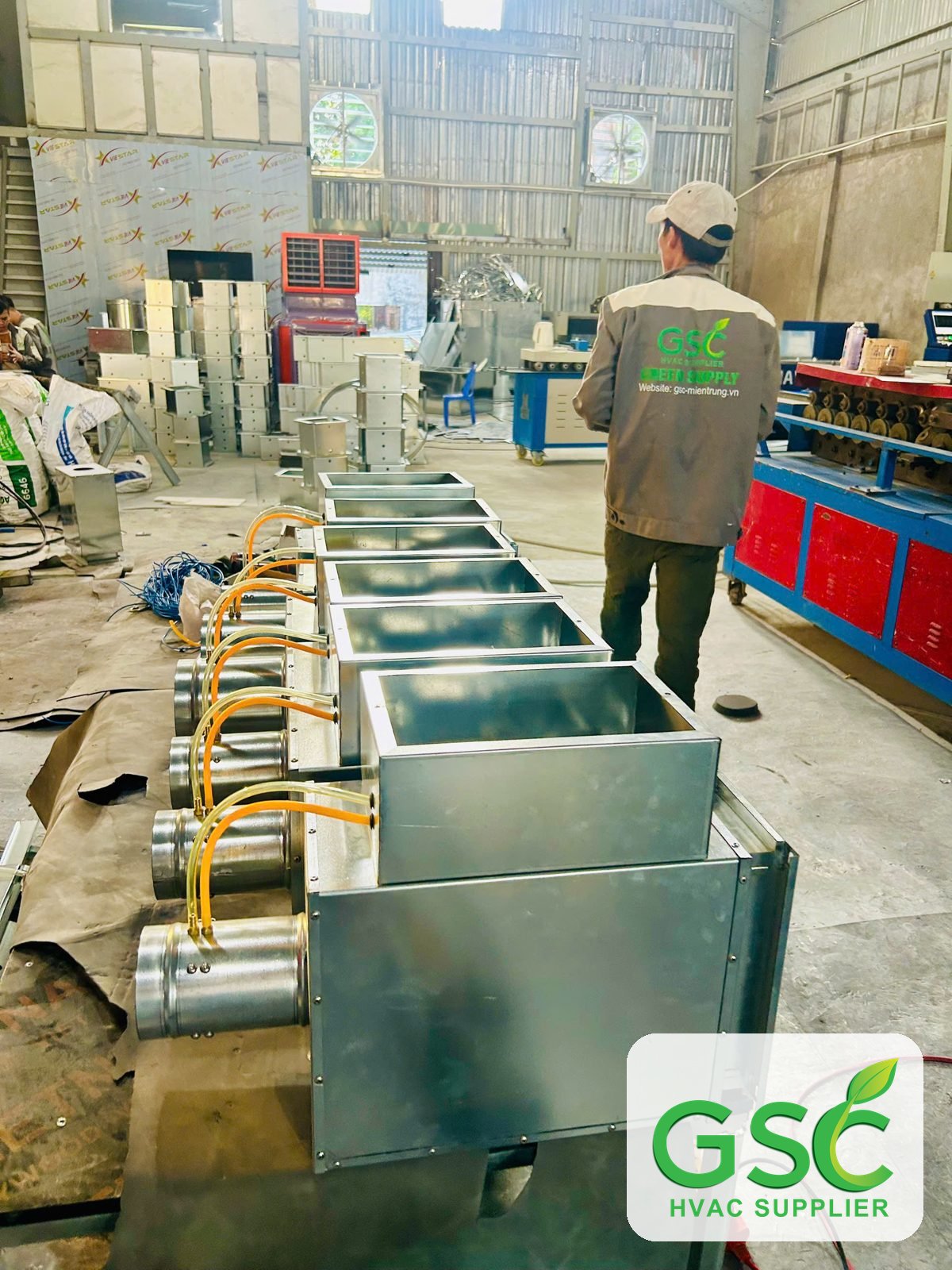
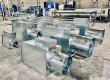
A batch of round VAV boxes at the GSC workshop, with flow-sensor tubing connected, awaiting inspection before shipment.
| Model | Size (in) | Inlet Ø D (mm) | Box W×H×L (mm) | Max airflow (m³/h) | CFM | L/s | Outlet A×B (mm) | Kg |
|---|---|---|---|---|---|---|---|---|
| VAV/CAV.04 | 4 | 102 | 300×200×400 | 357 | 210 | 99 | 250×150 | 7 |
| VAV/CAV.06 | 6 | 152 | 300×200×400 | 850 | 500 | 234 | 250×150 | 7 |
| VAV/CAV.08 | 8 | 203 | 300×250×400 | 1,479 | 870 | 411 | 250×200 | 8 |
| VAV/CAV.10 | 10 | 254 | 360×310×400 | 2,278 | 1,340 | 632 | 300×260 | 10 |
| VAV/CAV.12 | 12 | 305 | 400×380×650 | 3,417 | 2,010 | 949 | 350×330 | 15 |
| VAV/CAV.14 | 14 | 356 | 500×450×650 | 4,505 | 2,650 | 1,251 | 450×400 | 20 |
| VAV/CAV.16 | 16 | 406 | 600×450×760 | 6,460 | 3,800 | 1,793 | 550×400 | 25 |
For rectangular ducts, GSC manufactures to W×H dimensions from 200 to 1,000 mm (100 mm steps), with a box length L = 580 mm. Rated airflow follows the ASHRAE Handbook 2015, Chapter 48: Fmin at a velocity of 2.0 m/s, Fmax per the catalogue table.
Formula for engineers to self-check: Q (m³/h) = W (m) × H (m) × v (m/s) × 3,600. Example, a 500×400 box at 2.0 m/s: 0.5 × 0.4 × 2.0 × 3,600 = 1,440 m³/h.
| Size W×H (mm) | Fmin at 2.0 m/s (m³/h) | Fmax per catalogue (m³/h) |
|---|---|---|
| 200×200 | 288 | 1,440 |
| 300×300 | 648 | 3,240 |
| 400×300 | 864 | 4,320 |
| 500×400 | 1,440 | 7,200 |
| 600×500 | 2,160 | 10,800 |
| 800×600 | 3,456 | 17,280 |
| 1,000×1,000 | 7,200 | 36,000 |
The full table of 81 sizes is in the GSC VAV/CAV box catalogue.
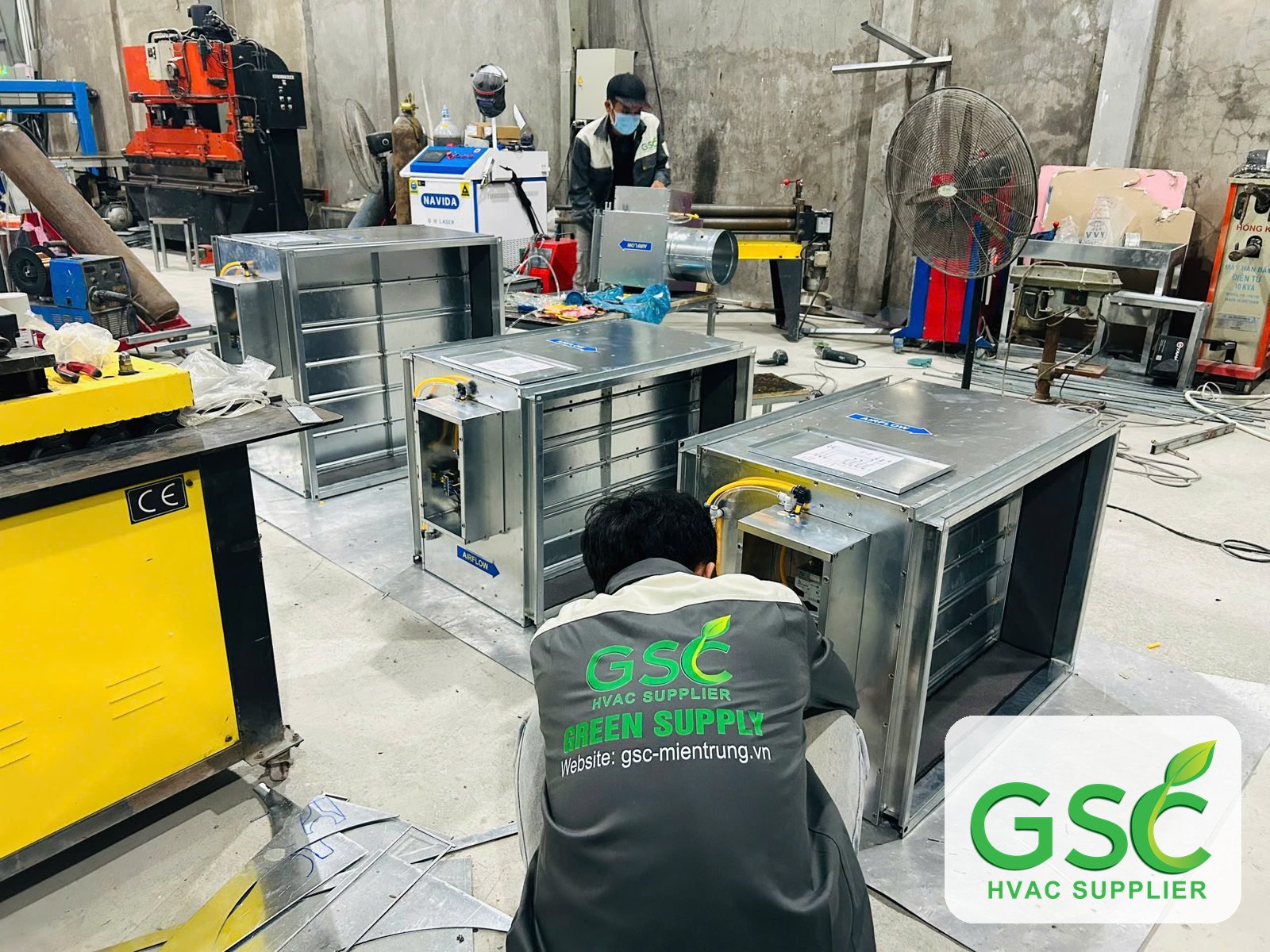
Fabrication of rectangular VAV boxes at the GSC workshop.
Since the October 2026 catalogue, GSC has added the VAV Universal room pressure line (model GSC-VAV-P.W×H). Instead of controlling on temperature, the box maintains positive or negative room pressure, for cleanrooms, isolation rooms, operating theatres and laboratories.
| Component | Model | Function |
|---|---|---|
| Room pressure controller | Belimo VRU-M1R-BAC | Integrated M1R differential-pressure sensor, −75…+75 Pa range; BACnet MS/TP, Modbus RTU or MP-Bus communication; configuration via Belimo Assistant 2 |
| Actuator | Belimo LM24A-VST | 5 Nm rotary motor, AC/DC 24 V, quick-connect to the controller; suits dampers up to about 1 m² |
| Casing | Mag Shield steel | Corrosion resistant, suits humid environments |
Example: an office zone needs Vmax = 1,500 m³/h, Vmin = 500 m³/h.
Quick conversions: 1 CFM ≈ 1.699 m³/h; 1 L/s = 3.6 m³/h.
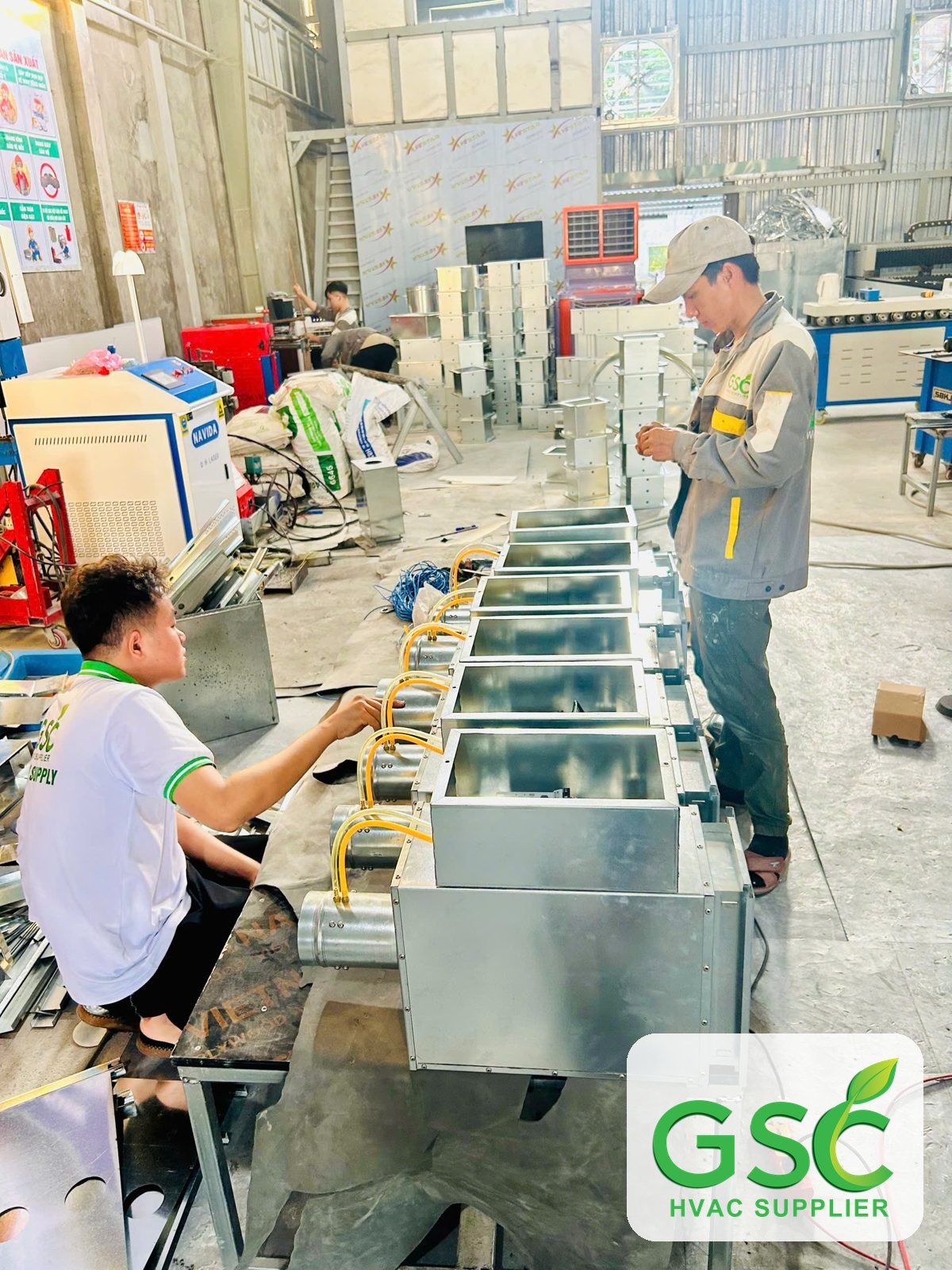
GSC technicians checking sensor connections on a VAV box batch before delivery.
Must a VAV box connect to a BMS? No. A VAV box can run standalone with its thermostat. BMS connection via BACnet MS/TP or Modbus RTU adds monitoring, scheduling and AHU fan optimization to actual demand.
How much energy does a VAV box save? It depends on the hourly load and the AHU inverter. By the fan law, fan power falls roughly with the cube of speed, so a 20% airflow reduction can cut fan power by almost half (0.8³ ≈ 0.51). Actual figures must be calculated for each project.
When should I use a CAV box instead of a VAV box? When the area needs fixed airflow: fresh-air supply, exhaust, corridors, technical rooms.
Does GSC make rectangular VAV boxes to custom sizes? Yes, from 200×200 to 1,000×1,000 mm in 100 mm steps.
Which type for cleanrooms and isolation rooms? The VAV Universal room pressure line (GSC-VAV-P), which controls on room pressure in the −75…+75 Pa range.
Send your zone airflow schedule or BOQ via Zalo/Hotline 0905 604 970 or email gsc.mientrung@gmail.com. GSC will select sizes, check Vmin/Vmax and quote the same day.
View the VAV box product page · Download the VAV/CAV box catalogue (PDF)