A CAV box (Constant Air Volume) holds a fixed airflow for an area, while a VAV box (Variable Air Volume) changes airflow to match demand (usually room temperature). Both are terminal units with a damper, a flow sensor and a controller, installed in the duct upstream of the diffuser. The difference is which airflow value the controller follows, and that decides selection, cost and energy savings.
This article is for design engineers, MEP contractors and owners choosing the right box for each zone. Size data follows the GSC 2026 CAV/VAV catalogue.
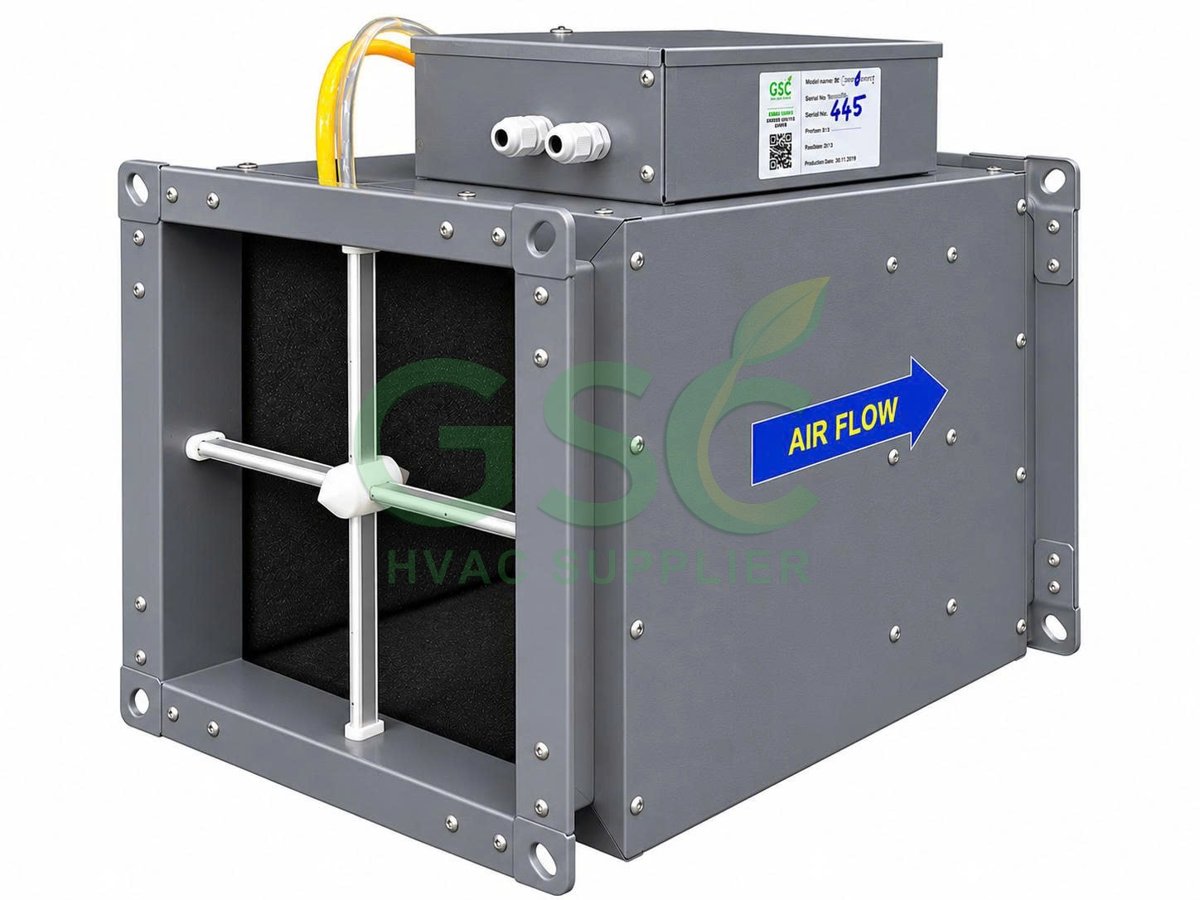
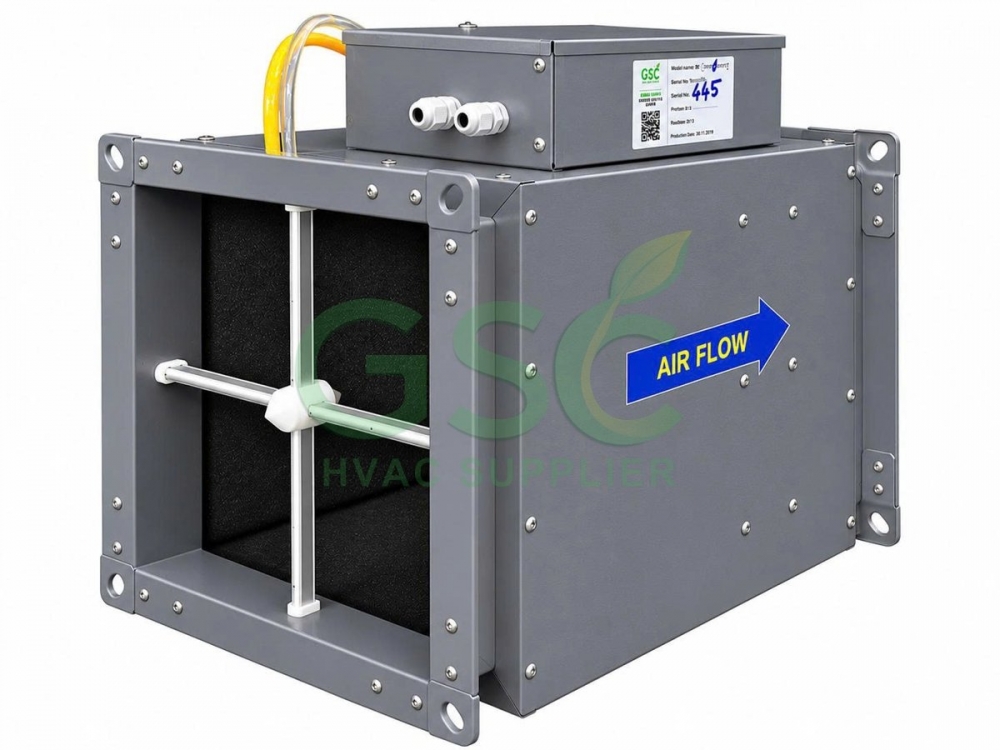
Illustration: GSC rectangular VAV/CAV box — damper, internal acoustic lining, flow-sensor tubes and controller enclosure.
| Criteria | CAV box | VAV box |
|---|---|---|
| Airflow | Fixed at the set value | Varies between Vmin and Vmax with zone demand |
| Control signal | No thermostat; the controller only holds the set airflow | Thermostat (or CO₂ sensor) decides the airflow required |
| When main duct pressure fluctuates | Airflow is maintained (pressure independent) | Airflow follows the demand (pressure independent) |
| AHU fan energy savings | None — fan load stays almost constant | Yes — AHU fan slows down when many zones reduce load |
| Equipment and controls cost | Lower (no thermostat supplied) | Higher (thermostat included, BMS connection possible) |
| Typical applications | Fresh air, exhaust, corridors, technical rooms, areas needing steady airflow | Offices, hotels, retail, schools, hospitals, airports |
Note: both GSC lines share the same casing and size table (models GSC-CAV.xx and GSC-VAV.xx), so switching from CAV to VAV at design stage hardly changes installation dimensions. The catalogue states that the CAV box does not include a thermostat.
The sensor measures differential pressure across the inlet; the controller compares it with the set value and drives the damper actuator so airflow stays constant even when duct pressure changes. Suitable when the zone load is constant or when a minimum airflow must be guaranteed (fresh air, exhaust).
The thermostat measures room temperature, the controller calculates the airflow needed and drives the damper between Vmin and Vmax. According to the GSC catalogue, a VAV box has 3 operating modes:
| Area / requirement | Recommended | Reason |
|---|---|---|
| Offices, hotel rooms, shops — load varies with time and occupancy | VAV | Large load variation gives the clearest fan energy savings |
| Fresh air supply per floor/zone | CAV | Design requires a fixed fresh-air flow |
| Toilet, kitchen, technical room exhaust | CAV | Steady exhaust flow, independent of temperature |
| Corridors, lobbies with stable load | CAV (or VAV if a BMS is used) | Little load variation, so VAV adds little benefit |
| Rooms needing pressure control (cleanrooms, isolation, operating theatres) | Room-pressure VAV | Control by pressure is required — see our dedicated article on room-pressure VAV boxes |
| Projects planning BMS integration and per-zone monitoring | VAV | Belimo controller communicates via BACnet MS/TP or Modbus RTU |
|
Selection notes • A system often uses both: VAV for conditioned zones, CAV for fresh air and exhaust. • VAV saves energy only when the AHU has a variable speed drive and fan-speed logic based on duct pressure. If the AHU fan runs at fixed speed, most of the benefit is lost. |
Assumptions (illustrative example, replace with project data): an office zone needs a peak airflow of 2,000 m³/h and a minimum fresh-air flow of 600 m³/h; a rectangular VAV box is selected.
Result: choose W300 × H200. Rule of thumb: pick a size so the zone Vmax falls between 70–100% of Fmax and Vmin is not below 20% of Fmax. The result must be confirmed by the design engineer against the catalogue operating static pressure of 50–250 Pa.
By the fan laws, fan power is roughly proportional to the cube of speed. Assuming the AHU fan has a variable speed drive and airflow drops by 20%, power falls to about 0.8³ ≈ 0.51, almost half the fan energy at that moment. This is a theoretical calculation; actual savings depend on the load profile, duct pressure setpoint and drive efficiency, so each project must be calculated separately.
With CAV the AHU fan runs at nearly one operating point, so there is no such saving. In return the equipment is simpler and cheaper, so CAV remains the right choice for fresh air and exhaust.
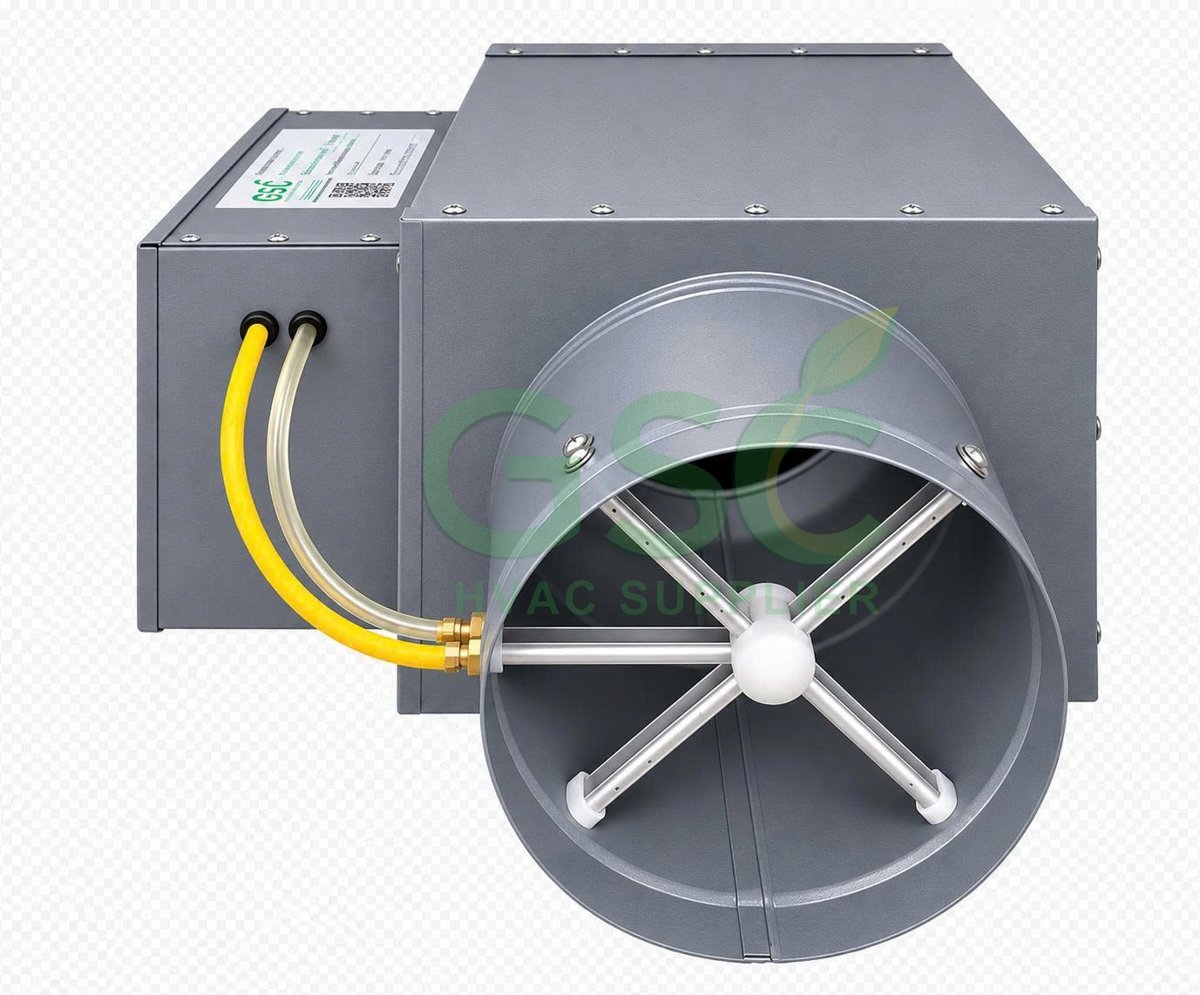
Illustration: GSC round VAV/CAV box — cross-shaped flow sensor inside the inlet, sensor tubes and controller enclosure.
Does a CAV box need a thermostat? No. A CAV box holds a fixed airflow, so the GSC catalogue does not include a thermostat.
Can a CAV be converted to VAV after installation? Dimensions follow the same size table, but a thermostat must be added, the controller reconfigured and the AHU fan logic rechecked. Please contact GSC to review each case.
Can a VAV box work like a CAV? You can set Vmin equal to Vmax to fix the airflow, but using the right type from the start is neater and cheaper.
How is a CAV/VAV box different from a plain volume control damper? A manual damper only sets the opening, so airflow drifts when duct pressure changes; a CAV/VAV box measures actual airflow and compensates automatically (pressure independent).
Send the zone airflow schedule or BOQ via Zalo/Hotline +84 905 604 970 or email gsc.mientrung@gmail.com — GSC recommends CAV or VAV for each area, selects sizes and quotes the same day.
VAV/CAV box product page · Download the VAV/CAV box catalogue (PDF)